Showing posts with label wild food. Show all posts

Thursday, 11 June 2015

The Pigeon Dilemma


I'm back! Well it seems like I haven't posted much in ages as there just hasn't been a spare minute. Bear's challenge has gone out of the window for another month, although there was some closure on the pigeon front.....


I had the opportunity to go for a walk in Bramcote Park in Nottingham, which is quite lovely despite the background hum of traffic. I chatted with friendly dog walkers, spotted a few familiar wild foods and was just generally enjoying the evening, when there was a 'plop'. I was walking through some trees and something small had fallen out of one of the trees. I turned round to investigate and found a dead pigeon on the ground with a bundle of soft fluffy feathers beside it. The bundle of fluff was a baby pigeon still clearly alive, but with a cracked beak and it must have literally dropped out of the tree just as I walked past.


Dilemma. The parent bird had clearly been killed by a cat or fox ( I am thinking cat, because it wasn't eaten whereas a fox would have had it for dinner). The young pigeon's feathers were not mature enough to fly and it would no doubt die without a parent bird, even if the damaged beak recovered. Why did it plop down next to me?


I could see the nest in the tree and it was too high up for me to reach, but with my heart thumping I grabbed the scared little bird and tried to balance it on a lower branch in the hope it would climb back. Plop!

Now I stood for several minutes thinking this through. There was absolutely no way I could save this bird or any hope it would survive. I have saved baby blue tits before, but they had fully fledged wings that had got wet in a shower, so lifting them into a hawthorn bush until their wings dried out meant they had a good chance of surviving. This pigeon had none. Plus they are classified as a pest (for good reason) so you are not supposed to rescue them.


Could I kill it? It was clearly going to die anyway, so a quick bash with a stick would save it from suffering. I still couldn't do it and just walked away. Let nature take its course and no doubt something will come and eat it.....just not me.


And so the great pigeon question has been answered - roadkill I can just about handle. Killing is something I am still not ready for. It does seem rather pathetic, but I am being honest with myself, which would be fine if I was a vegetarian, and wasn't expecting other people to kill animals for me to eat.

I have watched some of 'The Island with Bear Grylls' series 2, where a group of women and a group of men were left to survive on separate desert islands. It was interesting to see the women struggling with the dilemma of killing their adopted pet piglets (episode 6), which they aptly named Sage and Onion. In a situation where you are starving hungry your survival instinct clearly kicks in and they describe not thinking of them as animals anymore, just food. If you think you have the strength for this then you can apply for the next series here.

Thursday, 23 April 2015

Tastier Than Bear's 6: Meat on the Menu

A lot has been happening the last few weeks, and I have a so much to blog about, yet very little time. I left you all on a cliff-hanger over 2 weeks ago with my quest to kill a pigeon, so it seems only fair that I start with an update on my foraging antics.

Well................I still haven't killed a pigeon, though I bought Hugh Fearnley-Whittingstall's 'The River Cottage Cookbook' (at the carboot sale for 50p) which follows his early antics at River Cottage. He has a whole chapter on Hedgerow, including wild meats, and is informative on preparing pigeon, rabbit, squirrel and ......snails (Hugh and Bear would get on a treat!). So having read more on the subject, I am feeling much more prepared for the pigeon-caught-in-a-net day to arrive.

 
But all was not lost on the meat front. Driving along a country lane I spotted some road kill. It was a cock pheasant and looked in very good condition, considering it had been hit by a car. I quickly jumped out and having some compost sacks in the boot, I stuffed the pheasant inside one and drove off full of excitement. This was it - true foraging with my first road kill dinner!

I was heading to collect horse manure from Suella, who is always very generous at sharing her horses' produce and there was quite a gathering. So I consulted with the wise Suella, Janet and Martha on my road kill and the first question was 'Is it still warm?' Why did that not occur to me? I had managed to bag the carcass without touching it, so I tentatively reached inside and yes it was warm, so very fresh. It was a bit smelly, but as they pointed out 'All living creatures are smelly'. Here it is.


Note to self: Don't stuff it in a bag next time, lay it flat! Nice how David Cameron is thoughtfully positioned to be consulting with my dead pheasant ;-)


Hugh doesn't mention pheasant, so I checked out some simple techniques on YouTube for removing feathers and gutting, but they all had shot birds whereas mine was already a bit damaged with guts spilling out. I was quickly losing my nerve, as a pre-packaged chicken doesn't come with the same smell, feathers, feet and undigested corn falling out. So I just dived in and cut out the breasts and quickly discarded the rest. I know it was such a waste, but I was overcome with squeamishness. Bear just rips off the head, feet and wings and skewers it for the fire, but I am not up to that yet (if ever).


I calmed down once faced with just the 2 pieces of breast and chopped them up for a stir-fry. I then dashed out to the woods (not shops) for some accompaniments - more wild garlic, hogweed shoots and stinging nettles.


I decided to break the rules and use some olive oil for frying as it is much easier than to keep adding dribbles of water. The hogweed shoots are absolutely delicious fried and were the best tasting part of the meal still. I may have forgotten to mention that I ate them last week on a bed of dandelion leaf salad, and they are so much more delicious fried than steamed.


The pheasant wasn't gamey (probably because it was too fresh), but rather plain and overcooked. I had thought to cook the breasts whole, so that I could leave them pink in the middle, but this was road kill and overcooked seemed a far safer option, if somewhat less appetising.


So I have eaten foraged meat and I survived ;-) There may be more meat menus to follow, if I can catch one of those darn pigeons.

Monday, 6 April 2015

Tastier than Bear's 5: Not quite pigeon

Well, Bears challenge has gone out of the window last month. Partly because it has been a busy month at the allotment and partly because I have set my sights higher for the next meal. The last meal had basically composed of a salad, and really I wanted to find some more nutritious food for the next meal. So I decided to target 2 new foods.

The first is pignuts. Not only do these involve a bit more pre-meditation than just pulling a few leaves while I am out walking, because I need tools for digging up the root and permission to dig, but I am having trouble identifying them without digging up the root. There are loads of plants with similar leaves in my woods, but they may also be something nasty like Hemlock, which is somewhat similar. So I need to take a mat and some plant identification books and sit and investigate, which needs the luxury of time and weather.

The second is pigeons. Yes I am carnivore and though I am not keen on eating bitter wiggly worms like Bear Grylls, I am game for some pigeon. A google search for pigeon brings up some really mouth-watering recipes. The wood pigeons we get in the garden have been grazing on locally grown vegetables, bird seed and other delights from the fields nearby, whereas city birds scavenge on rubbish so may not be a good idea. The problem of course is how to catch one and kill it. Road kill is definitely an appealing option, as I am used to dealing with dead carcasses, rather doing any slaughtering myself, but I have not been in luck.

Mr Twit used Hugtight Sticky Glue, pasted on the branches of a tree to trap birds for his bird pie. I must admit that it does seem a simple idea, not requiring any skill in the catching, but it is also indiscriminate. We really get some of the fattest pigeons in our garden, so a couple of years back, son and hubby decided to rig a trap. It involved my washing basket, propped on a stick. There was a rope tied to the stick and the other end was held by my son, who was sat in a camouflaged hide a few metres away. It was very entertaining, and as you might imagine totally unsuccessful! The pigeons were far too wily to walk under the basket. It was also somewhat of a relief because I didn't really think that either of them would be happy with killing their victim, and I did not want to be the one to do it.


So my mind had moved from traps to weapons. Eldest son has offered to shoot them with his bow and arrow, but having such a small garden with a public path along the side, I am scared of stray arrows causing harm. Maybe I could learn to master a slingshot, although I am the most appalling aim, and slow to boot. Look at these fancy ones which you can buy with seedball ammunition! At worst I would scare the pigeons off my vegetables, and if I got lucky, dinner would hopefully be dead from the impact.

But what if the pigeon was just injured and I had to catch it and kill it? There was only one thing for it. I needed help from an expert. The allotment is full of such experts. The netting designed to protect tender plants from the voracious appetite of greedy pigeons, is not always pigeon proof. A couple of times last spring I saw pigeons that had found a hole to get in, then couldn't escape .......the perfect pigeon traps! I have enlisted the help of an allotment friend and the next time a pigeon is trapped she will guide me to catch it and kill it. She seems quite an expert despite being a vegetarian, and has already dispelled my image of breaking it's neck, as apparently it is too easy to pull the head off - yuk! Bashing it over the head is her preferred technique. You really are going to have to stay tuned for a few more weeks to see whether I have the nerve to pull this one off.


There were several foraging successes this month though, although not a completely foraged meal. The wild garlic leaves are out everywhere now, so I felt no guilt in picking a bag full of leaves and making a batch of wild garlic pesto, following the recipe in the River Cottage Handbook No. 7: Hedgerow by John Wright which is shown below.

50g Wild garlic leaves
30g Pignuts/ cobnuts/ pine nuts, lightly toasted in a pan (I doubled this amount)
30g Parmesan cheese grated
80ml Olive oil plus extra to cover
Salt and pepper to taste

Put in a food processor and blitz, slowly adding the oil. Transfer to a jar and make sure the pesto is covered with olive oil. Keep in fridge for several weeks.


Having not found any pignuts, I roasted some of my remaining cobnut stash, but the resulting pesto was like extremely strong raw garlic. I threw in an equal amount of pine nuts, which balanced out the flavour enough so that I could taste it without burning my mouth. A small spoonful added to pasta sauce is great! Or even as a substitute for garlic butter in garlic bread or very sparingly in a salad dressing.


I also picked a bag full of nettle tops. I think I suffer with mild arthritis in the joints in my hands and have found that nettle stings seem to help. I run my hands through the nettles until they are stung all over, then quickly rub some chewed up plantain over my hands to stop the stinging. The stings still tingle for up to 24 hours, but after that scrubbing the bathroom or weeding the garden doesn't make my joints ache.

The nettle tops were so bright and fresh looking. I made them into nettle soup using another River Cottage recipe. It tasted good, though was not thick enough for my liking, so I will add more potato or some swede next time.


Half a carrier bag of stinging nettle tops
50g butter
1 large onion peeled and chopped
I litre vegetable or chicken stock
1 large potato, peeled and cubed (or maybe 2 if you like a thicker soup)
1 large carrot, peeled and chopped
Salt and pepper to taste
2 tbsp. crème fraiche
A few drops of extra virgin olive oil
A few drops of Tabasco

Melt the butter and cook the onion until soft. Add stock, nettles, potatoes and carrots. Simmer for about 15 mins until potato is soft. puree with a stick blender and season to taste. Spoon into bowls with a teaspoon of crème fresh and drizzle of olive oil and tabasco.

I also picked some hogweed shoots and had them steamed with some chicken risotto. They do resemble asparagus in the texture, though not quite as delicious. Certainly very edible and something I will pick again.


I am still learning new plants all the time and keeping my eyes peeled for any delicious morsels, but growing vegetables is more productive and has to take priority for me over spring, whilst there is so much to be done.

Friday, 13 March 2015

Tastier than Bear's 4: Allotment weeds

I am getting a little behind on my foraging challenge, partly because the weather has improved and I have spent more time at the allotment, throwing a ball for the dog, rather than taking her on walks. I have fixed the shed door, spread my remaining manure, planted fruit trees and bushes, and dug up buckets and buckets of couch grass, mixed in with the threads of old carpet.

 
There has also been Transition meetings, including a lovely seed sowing workshop last weekend, led by a very patient and knowledgeable Andy. My youngest daughter said, "How can you do a workshop on sowing seeds - you just get some soil and put them in!" How little she knew! I picked up lots of tips, such as what compost to use and mixing in a little sharp sand for moisture retention. I also had a chance to ask questions about things that had gone wrong for me. And of course it was a very sociable event with home made refreshments too. If you are local you can check out the Transition Loughborough website for upcoming events.


Then this Sunday was the first car boot sale of the season. I decided to have a stall selling, the idea being that I raise funds to spend in following weeks. It turned out to be a very quiet event, so I didn't do as well as I had hoped. Still I emptied a few bags of outgrown clothes from the garage and made £21. Except that I spent £2 on a new basket, £2 on a wheely trug, 50p on a bag and....50p on something else that I can't remember.


I also attended my first ever political meeting, as Amelia Womack, deputy leader for the Green Party was speaking locally. There will be a general election in May, and for the first time we will have a member of the green party standing locally. It was an opportunity to hear their policies and ask some important questions, and Amelia was a friendly and easy to follow speaker. She certainly gave me food for thought. And talking of food.......


It turns out that Couch grass roots are edible. Wish I had known that before I dumped buckets full of them.


Actually they smell quite sweet, so they should make an interesting basis for a meal. So this weeks theme became allotment weeds. Alongside the couch I collected some red dead nettles again as they were so plentiful and pretty, a few stinging nettles as they needed to be weeded anyway, and the two new flavours of chickweed and hairy bittercress. How does this look for a bagged salad?


There was groundsel growing in and around the chickweed, so I brought some home to look up and was shocked that some websites described it as a salad plant whilst others said it was seriously toxic. I wasn't going to take a risk, but it just goes to show that it is worth double checking everything before you decide to eat it.

The chickweed had very pretty, distinctive white flowers, but they had closed up completely by the time I got my camera out. The stem has a single line of hairs down it, which help with the identification. John Wright describes the flavour of chickweed in The River Cottage Handbook No.7: Hedgerow as "...mild and pleasant, not unlike lettuce but with a bit of freshly mown cricket pitch thrown in." I had collected loads, and though it had a nice texture, the cricket pitch flavour was too much for me, so I only used a small handful.


The hairy bittercress was amazing though. It smelled and tasted just like cress and was not bitter at all. I mixed it in with the chickweed and some raw red dead nettles for the salad, but unfortunately the lovely cress flavour didn't come through. Maybe I need more next time.


It would definitely work in egg sandwiches. I will be keeping all the hairy bittercress I dig up from now on, or just nibbling it raw in between digging.


I fried the chopped couch grass roots with the nettles and some of the dead nettles, but I decided to taste them before adding them to my salad. Good job too, because they were really tough, like chewing twigs! The flavour was fine - no bitterness like the dandelion roots, but they were too tough to eat. Luckily I had picked lots of dead nettles, so I chucked the first batch with the couch grass away and fried the rest on their own.

 
The fried dead nettles really were the star of the meal and very tasty. The salad was a lovely texture, but raw dead nettles aren't as tasty as the cooked ones, and the chickweed was the overriding flavour. I won't use chickweed again, or else in very small amounts, because I am not so keen on the grassy taste. Still I finished it all off..... well apart from the couch grass. Glad I did throw bucketsful away, because you would have to be very desperate to try eating it.

 
Besides this week's meal I wanted to make another batch of dandelion coffee. The first attempt weren't roasted enough and tasted vile. The second attempt I followed guidance from River Cottage no.7 to cook them for 30minutes at 200 degrees C. They were burnt within 10 minutes, maybe because I had chopped them quite small and they were very dry to start with. Half of this batch weren't too burnt and it did make rather a lovely drink. Hopefully the next batch will be perfect again.


I also found some coltsfoot whilst I was walking round the local reservoir. It is supposed to be a good remedy for coughs, so I will pick a few more to dry next time, because it wil be good to have some remedies in for next winter. I have just dried a bunch of sweet violets on my windowsill too


Every time I am out, I have brought one or two plants back for identification and tasting, so I am gradually increasing my wild plant knowledge. Where I really think that it will save me money is with herbal teas that I drink regularly, and with herbal remedies. I am gradually increasing my store of little bottles with dried plants, so that I should have enough variety to make more remedies soon. I had better start adding labels too, as I will no doubt forget what each one is! Let me know if you do any foraging or make any wild remedies?

Saturday, 28 February 2015

Tastier than Bear's 3: Wild garlic

I bet you thought I wasn't going to do my tastier than Bear's challenge this week. Well I did too.


It has been a busy week because I have been able to get to the allotment and crack on with the many jobs I need to catch up on. For instance I re-felted my shed roof in the bitter cold wind, and discovered that it was leaking because someone had screwed a baton down the centre of it. It's lovely and dry, if very untidy inside now. (Next job is shelves and hooks!)


The plan was to dig/weed a patch and plant some fruit bushes and trees and collect a bucket full of weeds for dinner at the same time. In the end it was quite hard work and poor weather, I was hailed on twice, so I was too busy to sort through any potentially tasty weeds.


The next day I walked the dog past my hazel patch and decided to see if there were still any fallen nuts lying around. There were loads, because the squirrels still haven't found this patch. They looked a bit damp and muddy, but I took a dozen home for inspection.


I also saw this lovely plant growing on the bank. It turns out it is Lesser Celandine, and I keep seeing it everywhere now. It isn't edible as such but is used as an herbal remedy for piles. The roots give you a clue! (Wild Drugs: A Foragers Guide to Healing Plants, by Zoe Hawes)


You never know, there may come a day when that knowledge is useful, although I sincerely hope not ;-)


The first cobnut I cracked open had a perfect little nut inside, and a small nibble confirmed that it wasn't bad but perfectly edible. Dinner was looking positive..........but then the next 11 shells were empty!


Maybe I would give up for this week, as February is such a lean unfriendly month for the forager. If I was hungry, then worms may possibly be on the menu at this point.


What a shame that the lovely looking jelly ears I see when I am walking are so unpalatable. There was no way I was picking them....unless I had something flavourful to cook them with.


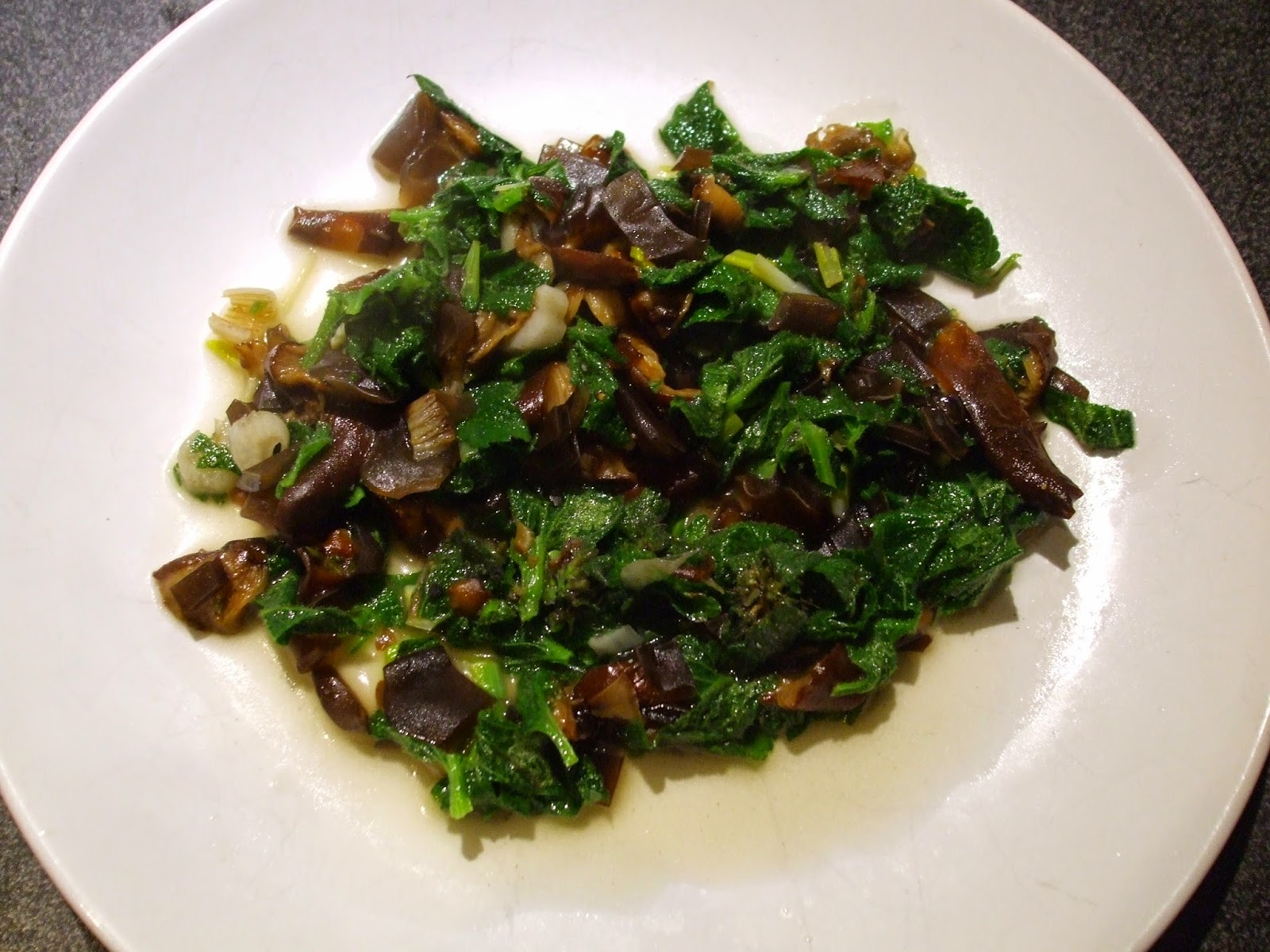
Then to my rescue I found the small and muddy shoots of some wild garlic (ramsons) whilst walking the dog. The amazing garlic smell is the sure-fire way to identify them. I only took a few shoots as the aroma was so strong, although the roots are edible too.


There is a fallen tree blocking the path at this point and it is so muddy that climbing over it is slippery and treacherous. So I decided to try and find a route round, going through the brambles instead.


I am so glad I did, because growing on the inside of the remaining tree stump were some clusters of velvet shanks. Visions of a garlicky mushroom medley were swimming through my head.


I collected some white and red deadnettles on my way home to provide the 'spinach' and picked the jelly ears. Close to home I decided to investigate these leaves again.


I had brought a few leaves home to identify previously, but without a flower they could have been anything. However this time as I picked the leaves I found little purple flowers hiding underneath.


Sweet violets - the smell confirmed it. Even the leaves seemed to bear the scent. 'Wild Drugs: a forager's guide to healing plants' by Zoe Hawes says that the dried leaves and flowers in an infusion are good for coughs and sore throats. I tasted a leaf, but it didn't have the taste of violet, so I made a cup of fresh violet tea. It was fine, not violet flavour, but very smooth and pleasant.


This was another very tasty meal, the wild garlic making all the difference.


I chopped up the jelly ears very small, in the hope of improving the texture, and fried them with the velvet shanks and garlic, throwing in the deadnettles at the end.


The taste was lovely, even the jelly ears just took on a garlicky flavour. They still had that crunchy slimy texture, but were much more edible in small pieces. If I had more velvet shanks I would have just left out the jelly ears though. There must be a better way of cooking them to tenderise them, and no doubt I will try again because they are so abundant!

I am looking forward to more wild garlic through March and have planted some cultivated garlic at the allotment as a more reliable garlic source. I wouldn't say growing garlic is a dead cert, mainly because of my dodgy gardening skills, but certainly less of a haphazard business than foraging for food is.