Showing posts with label allotment. Show all posts

Monday, 22 June 2015

Allotment progress

This is how the allotment has developed this year.


The plan had been to carry on with Charles Dowding's No Dig method, where you add a layer of compost or manure on the soil and let the worms do the work of digging it in for you. In my usual fashion I didn't get round to ordering another delivery of cow manure in the Autumn, and given how long the last batch took to breakdown I decided not to get any this spring. This has worked out for the best, as many of the other plot-holders believe the manure is contaminated with pesticides. The hormonal weedkiller used on grassland apparently goes through the cows without causing harm, but contaminates the manure. It may be that the manure I had last year was contaminated, which could explain a lot, but I really hope not. I am trying to grow healthy organic produce, so a hidden dose of chemicals is the last thing I want.


Instead, I have collected some horse manure from my friend Suella, who cares too much about the environment and her horse, than to cover her grazing land with chemicals. It is a peaceful setting, with some friendly conversation, so filling sacks and trugs with manure isn't a job that I mind doing. When I get back to the allotment though, the manure never seems to be enough.


I have had plenty of lovely compost for my garden from the double compost bin I made last year. I want to construct a compost bin made from pallets at the allotment, but I only managed to scrounge 3 pallets before my big car broke down and I need to find some smaller ones to fit in my smaller car. meanwhile the weeds are taking over!

I also have a 'dalek' compost bin, but it is full of ants. At the Composting Workshop held at the Transition Community Allotment a fortnight ago, I found out that this means that my mix is too dry and can be remedied by adding more greens. It was a very useful workshop even though I couldn't stay for it all. My plot has lots of comfrey now, some a gift from Suella last year, and some I found on the new half when I was clearing all the weeds.


I followed Mrs Thrifts recipe and made my first Comfrey Tea to feed my tomato plants. It really stinks, and if you get it on your hands you will need to wash them repeatedly to get rid of the smell. Every time I turned my back the dog was drinking it! Maybe she knows it is full of nutirents.


We have been eating lettuces and spinach for weeks, and it is so nice not to need to buy any from the supermarket. The spring onions are ready too, but I need to find a way to stop them going limp in the fridge. Any ideas?


I bought lots of seed potatoes from the Transition Loughborough Potato Day earlier in the year, and they are looking healthy despite the dog charging through them.


The grapevine that I pruned very hard has survived. The blackcurrant bush also seems to have relished the hard prune and is covered in berries. Plus the little gooseberry bush hidden under all the weeds has a handful of fruit nearly ripe.


I have built a couple of frames for netting, which have now been transferred from protecting the garlic and onions to covering the young brassicas. The garlic, gifted by another plot-holder, has been the first casualty this year, as it has white rot. Most of the other plot-holders seem to have suffered the same fate, but luckily my onions still seem healthy......for now.

I have peas growing in my garden at home where I have never needed to net them from the pesky pigeons. Yet at the allotment I risked leaving them unprotected and of course they have been gobbled. Enough have survived for me to have eaten my first peas today.


My kind neighbour has given me some chickpeas to grow this year. To play things safe I sowed them in 2 separate locations at the allotment and in my garden. The garden ones are doing the best. I can't wait for the soft little pods to grow, though if this cool weather continues I ma not get any.


I am not sure whether I mentioned that I planted some fruit trees, which were a gift from my parents. After lots of reading I decided on a Nashi pear and a sweet eating apple, along with some blueberry bushes and new raspberry canes.


The fruit trees both seem to be doing well and had lots of blossom and baby fruit, most of which I have removed. I surrounded them with bark to try to keep the weeds back, but really there is no chance of keeping them down..


The weeds seem to grow at double the speed that my plants grow so it is a constant battle to keep each area under control once I have cleared it. Plus the areas that I haven't yet managed to clear are now going to seed. I have put out a request on freecycle for chippings as bark is too expensive to cover large areas, but had no response yet. Old carpet is my best weed control for now, until I get on top of things (Will that ever happen?)


Anyway, most of my seedlings, that covered every windowsill for weeks, are planted out now. Just waiting for some more netting to be delivered so the last of the brassicas can go out protected from pigeons and butterflys. Then I can just sit back and wait for them to grow :-) Well..........apart from the watering, weeding, pinching out shoots, feeding, hoeing, tying and harvesting!


Happy growing!

Friday, 13 March 2015

Tastier than Bear's 4: Allotment weeds

I am getting a little behind on my foraging challenge, partly because the weather has improved and I have spent more time at the allotment, throwing a ball for the dog, rather than taking her on walks. I have fixed the shed door, spread my remaining manure, planted fruit trees and bushes, and dug up buckets and buckets of couch grass, mixed in with the threads of old carpet.

 
There has also been Transition meetings, including a lovely seed sowing workshop last weekend, led by a very patient and knowledgeable Andy. My youngest daughter said, "How can you do a workshop on sowing seeds - you just get some soil and put them in!" How little she knew! I picked up lots of tips, such as what compost to use and mixing in a little sharp sand for moisture retention. I also had a chance to ask questions about things that had gone wrong for me. And of course it was a very sociable event with home made refreshments too. If you are local you can check out the Transition Loughborough website for upcoming events.


Then this Sunday was the first car boot sale of the season. I decided to have a stall selling, the idea being that I raise funds to spend in following weeks. It turned out to be a very quiet event, so I didn't do as well as I had hoped. Still I emptied a few bags of outgrown clothes from the garage and made £21. Except that I spent £2 on a new basket, £2 on a wheely trug, 50p on a bag and....50p on something else that I can't remember.


I also attended my first ever political meeting, as Amelia Womack, deputy leader for the Green Party was speaking locally. There will be a general election in May, and for the first time we will have a member of the green party standing locally. It was an opportunity to hear their policies and ask some important questions, and Amelia was a friendly and easy to follow speaker. She certainly gave me food for thought. And talking of food.......


It turns out that Couch grass roots are edible. Wish I had known that before I dumped buckets full of them.


Actually they smell quite sweet, so they should make an interesting basis for a meal. So this weeks theme became allotment weeds. Alongside the couch I collected some red dead nettles again as they were so plentiful and pretty, a few stinging nettles as they needed to be weeded anyway, and the two new flavours of chickweed and hairy bittercress. How does this look for a bagged salad?


There was groundsel growing in and around the chickweed, so I brought some home to look up and was shocked that some websites described it as a salad plant whilst others said it was seriously toxic. I wasn't going to take a risk, but it just goes to show that it is worth double checking everything before you decide to eat it.

The chickweed had very pretty, distinctive white flowers, but they had closed up completely by the time I got my camera out. The stem has a single line of hairs down it, which help with the identification. John Wright describes the flavour of chickweed in The River Cottage Handbook No.7: Hedgerow as "...mild and pleasant, not unlike lettuce but with a bit of freshly mown cricket pitch thrown in." I had collected loads, and though it had a nice texture, the cricket pitch flavour was too much for me, so I only used a small handful.


The hairy bittercress was amazing though. It smelled and tasted just like cress and was not bitter at all. I mixed it in with the chickweed and some raw red dead nettles for the salad, but unfortunately the lovely cress flavour didn't come through. Maybe I need more next time.


It would definitely work in egg sandwiches. I will be keeping all the hairy bittercress I dig up from now on, or just nibbling it raw in between digging.


I fried the chopped couch grass roots with the nettles and some of the dead nettles, but I decided to taste them before adding them to my salad. Good job too, because they were really tough, like chewing twigs! The flavour was fine - no bitterness like the dandelion roots, but they were too tough to eat. Luckily I had picked lots of dead nettles, so I chucked the first batch with the couch grass away and fried the rest on their own.

 
The fried dead nettles really were the star of the meal and very tasty. The salad was a lovely texture, but raw dead nettles aren't as tasty as the cooked ones, and the chickweed was the overriding flavour. I won't use chickweed again, or else in very small amounts, because I am not so keen on the grassy taste. Still I finished it all off..... well apart from the couch grass. Glad I did throw bucketsful away, because you would have to be very desperate to try eating it.

 
Besides this week's meal I wanted to make another batch of dandelion coffee. The first attempt weren't roasted enough and tasted vile. The second attempt I followed guidance from River Cottage no.7 to cook them for 30minutes at 200 degrees C. They were burnt within 10 minutes, maybe because I had chopped them quite small and they were very dry to start with. Half of this batch weren't too burnt and it did make rather a lovely drink. Hopefully the next batch will be perfect again.


I also found some coltsfoot whilst I was walking round the local reservoir. It is supposed to be a good remedy for coughs, so I will pick a few more to dry next time, because it wil be good to have some remedies in for next winter. I have just dried a bunch of sweet violets on my windowsill too


Every time I am out, I have brought one or two plants back for identification and tasting, so I am gradually increasing my wild plant knowledge. Where I really think that it will save me money is with herbal teas that I drink regularly, and with herbal remedies. I am gradually increasing my store of little bottles with dried plants, so that I should have enough variety to make more remedies soon. I had better start adding labels too, as I will no doubt forget what each one is! Let me know if you do any foraging or make any wild remedies?

Saturday, 28 February 2015

Tastier than Bear's 3: Wild garlic

I bet you thought I wasn't going to do my tastier than Bear's challenge this week. Well I did too.


It has been a busy week because I have been able to get to the allotment and crack on with the many jobs I need to catch up on. For instance I re-felted my shed roof in the bitter cold wind, and discovered that it was leaking because someone had screwed a baton down the centre of it. It's lovely and dry, if very untidy inside now. (Next job is shelves and hooks!)


The plan was to dig/weed a patch and plant some fruit bushes and trees and collect a bucket full of weeds for dinner at the same time. In the end it was quite hard work and poor weather, I was hailed on twice, so I was too busy to sort through any potentially tasty weeds.


The next day I walked the dog past my hazel patch and decided to see if there were still any fallen nuts lying around. There were loads, because the squirrels still haven't found this patch. They looked a bit damp and muddy, but I took a dozen home for inspection.


I also saw this lovely plant growing on the bank. It turns out it is Lesser Celandine, and I keep seeing it everywhere now. It isn't edible as such but is used as an herbal remedy for piles. The roots give you a clue! (Wild Drugs: A Foragers Guide to Healing Plants, by Zoe Hawes)


You never know, there may come a day when that knowledge is useful, although I sincerely hope not ;-)


The first cobnut I cracked open had a perfect little nut inside, and a small nibble confirmed that it wasn't bad but perfectly edible. Dinner was looking positive..........but then the next 11 shells were empty!


Maybe I would give up for this week, as February is such a lean unfriendly month for the forager. If I was hungry, then worms may possibly be on the menu at this point.


What a shame that the lovely looking jelly ears I see when I am walking are so unpalatable. There was no way I was picking them....unless I had something flavourful to cook them with.


Then to my rescue I found the small and muddy shoots of some wild garlic (ramsons) whilst walking the dog. The amazing garlic smell is the sure-fire way to identify them. I only took a few shoots as the aroma was so strong, although the roots are edible too.


There is a fallen tree blocking the path at this point and it is so muddy that climbing over it is slippery and treacherous. So I decided to try and find a route round, going through the brambles instead.


I am so glad I did, because growing on the inside of the remaining tree stump were some clusters of velvet shanks. Visions of a garlicky mushroom medley were swimming through my head.


I collected some white and red deadnettles on my way home to provide the 'spinach' and picked the jelly ears. Close to home I decided to investigate these leaves again.


I had brought a few leaves home to identify previously, but without a flower they could have been anything. However this time as I picked the leaves I found little purple flowers hiding underneath.


Sweet violets - the smell confirmed it. Even the leaves seemed to bear the scent. 'Wild Drugs: a forager's guide to healing plants' by Zoe Hawes says that the dried leaves and flowers in an infusion are good for coughs and sore throats. I tasted a leaf, but it didn't have the taste of violet, so I made a cup of fresh violet tea. It was fine, not violet flavour, but very smooth and pleasant.


This was another very tasty meal, the wild garlic making all the difference.


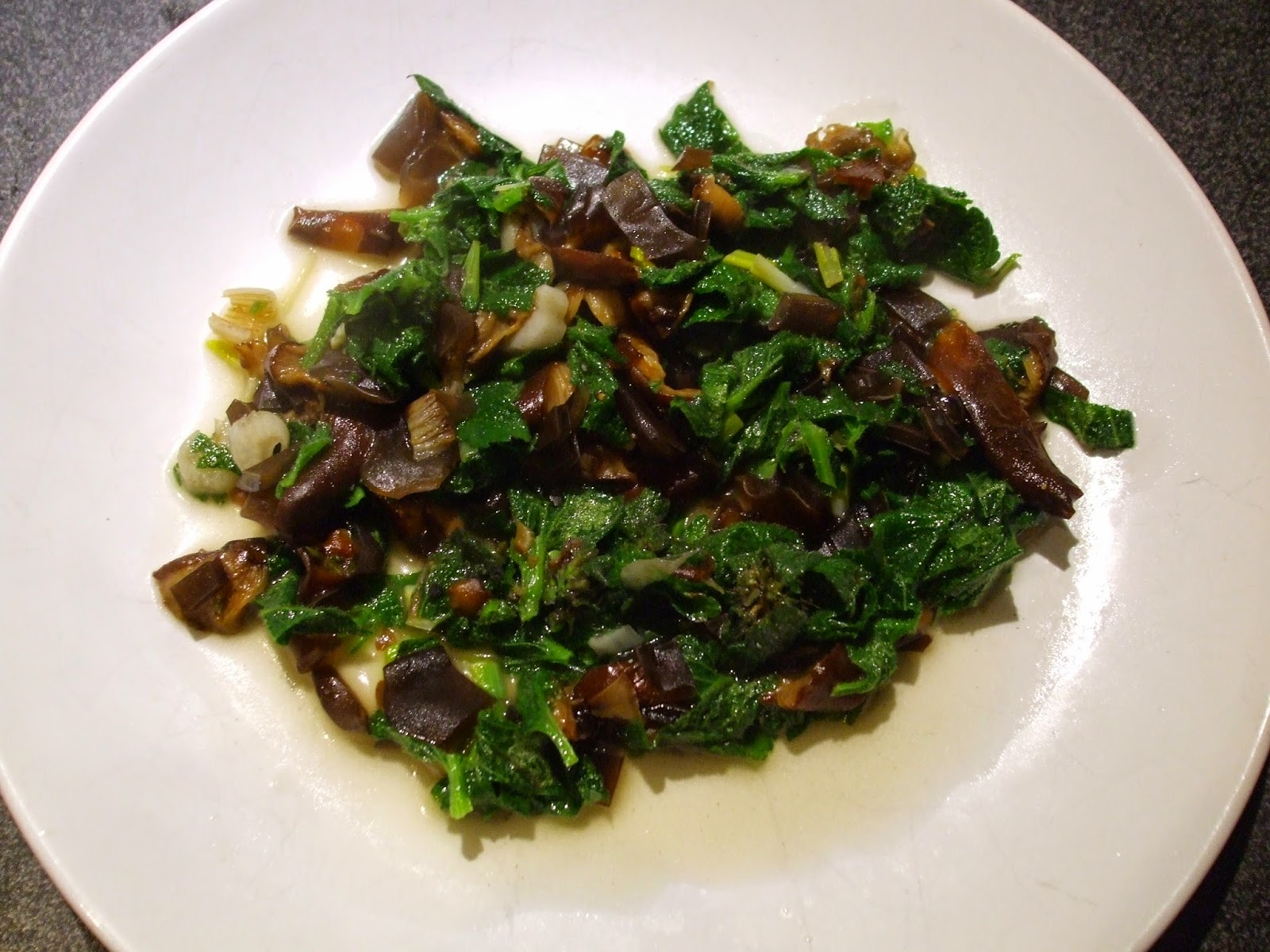
I chopped up the jelly ears very small, in the hope of improving the texture, and fried them with the velvet shanks and garlic, throwing in the deadnettles at the end.


The taste was lovely, even the jelly ears just took on a garlicky flavour. They still had that crunchy slimy texture, but were much more edible in small pieces. If I had more velvet shanks I would have just left out the jelly ears though. There must be a better way of cooking them to tenderise them, and no doubt I will try again because they are so abundant!

I am looking forward to more wild garlic through March and have planted some cultivated garlic at the allotment as a more reliable garlic source. I wouldn't say growing garlic is a dead cert, mainly because of my dodgy gardening skills, but certainly less of a haphazard business than foraging for food is.

Wednesday, 14 January 2015

Dandelion coffee

At the end of my first summer with half an allotment, I was lucky to be offered the other half of the plot.


Someone had taken it on about the same time I did, but soon packed it in. Shoulder high weeds took over and there were regular mutterings amongst the other plot-holders about "One year's seeds is seven year's weeds".


The allotment officer tried to find someone who wanted it, but no one lasted 3 days after that. This half is right next to the entrance gate, and a portion of it is allocated for the council's compostable waste bins, so it wasn't the most attractive plot. But now it is under my care :-)


My first job was to clear all the weeds and that job gave me my first harvest. Once the tall weeds had been cut back, I found the ground covered with Dandelions. Digging the roots up whole was quite a job, but some of the roots looked quite substantial. I don't like wasting anything, so I ended up bringing a sackful home.


Several got discarded on close inspection - half the dandelions suffered from insect damage, so what hope will my veg have! After a lot of scrubbing, they were chopped and dried and shrank down to just this......


And so they have sat on a shelf for a few months until I decided to try roasting a few for some dandelion coffee. One of my secondhand bargains over the summer was a hand-cranked coffee grinder. Of course now I had something to grind it wasn't going to work!


Undeterred I took it apart and realised it just needed tightening. So within minutes I had some freshly ground dandelion.


It did have a vague coffee-likeness, but was not so bitter and more like Barley cup. Very comforting on such a cold day. "Hedgerow Medicine" by J Bruton-Seal and M Seal suggests grinding a few pods of cardamom with it, or even cinnamon or fennel seeds. It is also good for you as it cleanses the liver and skin.


So if you are looking for a free, healthy, locally-grown, caffeine-free alternative, that you can harvest from virtually any garden, playing field or road verge..... then try dandelion :-)