Showing posts with label Climate Change. Show all posts

Friday, 24 July 2020

Looking forward to a brighter future

Recently I met with a friend in Melbourne, Derbyshire. It is a beautiful market town and we met by the church and walked past Melbourne Hall and The Pool then followed the footpath signs across fields and through woods on a lovely walk, ending up back in Melbourne a few hours later.
 
The Pool Melbourne

We had a fabulous time, chatting all the way. It was 7th July 2020 and the coronavirus lockdown was starting to lift, but everyone was still being cautious. It was such a joy to be out with a friend again enjoying the English summer at its peak. Did I mention it was raining?

Melbourne Hall
By the time we had returned to Melbourne we were soaked and hungry, but the pubs and cafes were still closed. We bought some sandwiches and tea from a bakery and sheltered from the rain under the marketplace pavilion. ‘Pavilion’ is maybe not the best description but I am at a loss. There were 4 benches facing outwards from the stone centre, the marketcross built in 1889, and a roof over us held up by wooden posts on each corner. We enjoyed sitting in the dry and watching the cars passing by, with a hot drink and some deep discussions, oblivious to the constant downpour.
 
The market cross
My friend told me about Professor Jem Bendell and ‘Deep Adaptation’. Bendell promotes the idea that we are already too far along the climate change route to prevent societal collapse, and that we should focus on enjoying the important things in life for the remaining years.

It doesn’t resonate with me. Rapid globalisation has created some big issues for the planet and I think most people recognise that in the core of their being without spending too much time on the over-whelming evidence supporting it, when they could be focusing on the solutions. I just don’t accept the ‘we are doomed’ conclusion, which isn’t new and has been pushed for the last 30 years or more. Plus define 'doomed', because it could be anywhere on a scale from a financial recession to extinction, and the most probable outcomes are somewhere between the two. 

There is plenty of evidence that indicates doom isn't upon us which I will touch on. I also feel that nothing positive will emerge from that kind of despair. People need hope and there is genuinely a lot to be hopeful for, though I may struggle to get it all in one post, so maybe this is the start of a new series of posts.

I read a few of Bendell’s blog posts and watched a couple of youtube videos. I was surprised that one of the proposals was that people concerned about climate change go through a stage of despair followed by a stage of prepping for collapse. I have been through those stages, but I always felt this was a complete anomaly in the UK. Even my friend sitting with me in the rain, who has supported the climate change movement for at least the last 15 years that I have known her, has not experienced that and we know no one else who has. If you have then please do get in touch either in response to this post or by private message to me. For me the stage after prepping is a deep understanding and knowing that there is a lot of hope and optimism for the future.

There is no disputing that there are some climate facts behind Bendell’s work, however I feel there are also some simplifications and a denial of progress and human nature, which skew his conclusion of collapse. There is a big difference between fact and theory or projections. Even with regard to facts they can look different dependent on what side of them you come from (your natural bias) and of course they can change with time. For instance the World population is a fact, but the figure changes daily. What I am saying is that nothing is fact and everything is in flux and in particular anything predicated on human behaviours and reactions. Experts struggle to predict next week’s weather, so looking further in the future is unreliable. Anything can happen today that could change everything tomorrow… and it frequently does.

What I didn’t like about this Deep Adaptation video on youtube is the comment below it that states:
As Dr. Bendell notes, there will be a tendency to want to reject his conclusions in Deep Adaptation since to accept them is so life changing in its repercussions.
You may also want to dismiss Deep Adaptation because you simply disagree with their conclusions, but with this sentence Bendell has dismissed every argument against his theory as coming from someone ‘in denial’. In addition he talks about the middle classes in his posts, and maybe he means that middle class society is collapsing and if it is hurray, because I am all for a classless society. However it does seem to overlook that it is the working class who are the collective power behind change (as well as being the least burden on the climate) and that there is a lot missing from this research if large parts of the population are overlooked.

My friend took from Bendell that collapse is inevitable, so stop worrying and spend the remaining years on things that have meaning for you. The perception being that Collapse means an end of life/ mass extinction event, rather than an end of a way of life such as a breakdown of current societal norms. Collapse represents fear, and just the word pulls the mind into a fear-driven frenzy where logic and reason jump ship and denial seems like a viable option. So let’s replace ‘Collapse’ with ‘Change’. There will be changes, there has to be changes in our society and history shows that there always have been changes.

Tobacco smoke is a killer, and in order to persuade people to quit smoking every packet has a disturbing image of the damage it has inflicted on some smokers. It looks pretty scary and if I were a smoker I would think that I was damned to die of some horrible lung disease or cancer before too long. The emphasis on the worst case scenario is aimed at scaring people into changing their smoking habit. For some people it makes the future look hopeless, so they may as well continue to enjoy smoking as they will be dead soon anyway. And yet we all know of someone who smoked until they were 80 with no sign of ill affect at all. How can that be? Maybe that future is not written in stone?

We are focusing on the worst case scenario for a smoker. That’s what we are doing with climate change too. This may scare us into changing our lifestyles or putting legislation in place and on the whole it has had that effect. However it can also cause people to become paralysed by fear or believe any efforts are futile. But there are other ways for positive change to come about and it is far better that we enjoy and embrace those changes because then they will be changes that are here to last.

I was given a book for Christmas “The Uninhabitable Earth – A story of the future” by David Wallace-Wells. It’s a shocking title but drew me in with the promise of an envisioned future. I only made it to page 44 and the weight of all the depressing, boring facts and figures that were being driven down to make you feel the full weight of hopelessness was enough. So I skipped to the back to see what the bright future might look like, but it was pretty much more of the same. Now if you have more stamina than me and have read this book in its entirety then please do enlighten me about the good parts that I have missed, or even shout up just to let me know you have not died of despair. I am a solutions person. I wanted to find someone who could envision the future for us and see the solutions - what is the use banging on about the same old stuff?

Wallace-Wells message is the equivalent of the stark image of lung cancer on a cigarette pack, I guess I have grown numb to it. Whereas the solutions such as banning smoking from public spaces worked just as well but without the fear factor. Providing solutions for people is a lot more empowering than just painting a bleak picture and leaving them paralysed. Obviously the fear factor is better for selling books…

Now I don’t deny that there is evidence that looks pretty bleak for the planet, but that evidence has been around for years. The Uninhabitable Earth has been compared to the Silent Spring by Rachel Carson published in 1962 and there has not been a silence regarding environmental damage in the years in between. I remember the mistake of bringing study material, Limits to Growth: The 30 Year Update, with me on holiday in 2006 and I sure felt the despair that Bendell talks about then!

The 30 year update was written in 2004 and the data used was from the years preceding that, and, well, things change. I think we only have to look at the growing proportion of renewables in the electricity grid in the UK to see that things change. Or the consistent tightening of energy efficiency targets in Building Regulations. Or the energy efficiency labels for cars, homes and white goods, with the commitments to phase out petrol cars completely. Standards are consistently being raised and maybe progress has started slow, but momentum is growing. The growth in globalisation completely over-shadowed the gains made until recently, and now there are more and more positive reports emerging. It’s clear that our perceptions and understandings of where we are need to change constantly and be open to the improvements we see, not just the devastation being caused.

There is definitely a delayed response in the updated facts being interpreted, understood and then disseminated and grasped by the wider community. Population growth is a good example of that and I would urge anyone who hasn’t yet seen the fantastic explanation by the late Hans Rosling back in 2013 to watch it. Even though the facts and figures have moved on already and there was more good news about population growth slowing further in the news this week. The message is clear that population is still increasing, but it is no longer accelerating. The continuing growth is down to the increase in life expectancy of people already alive, and is no longer due to birth rate which has dropped considerably (see below).

World fertility rates (births per woman), The World Bank,  


Birth rate is a clear area where the actual changes have to be taken by individuals. Yes education and access to contraception are vital to enable that, but couples have chosen to move away from the large families of their parents and grandparents. Who would have thought it was possible to change that on a global scale?

The coronavirus pandemic predictions were bleak in the UK. Maybe they needed to be to prod our slow and bumbling government into action. However the 250,000 – 510,000 deaths predicted for the UK on the 16th March by Neil Ferguson's Imperial College team were based on the worst case scenario. That worst case scenario may have been fairly accurate based on the information available at the time and the assumptions made. Those assumptions can make an enormous difference. That’s why there will be several scenarios run for different assumptions. The worst case is the do nothing scenario, the best case is that all infections are tracked and everything is under control, which was equally as unlikely in the UK as the worst case, however not totally impossible.


It is the same with the impacts of climate change, there is a range of ‘likely’ outcomes based on how much or little action is taken to reduce carbon emissions and mitigate the impact. My concern is that human nature seems to be misunderstood in modelling and some of the positive changes happening now are overlooked.

Most of the constructs which govern our society and dictate the actions of the majority are beliefs, traditions or habits. For instance families were large because they were for our ancestors and our neighbours, because there was and still is a belief perpetuated by religion that contraception is bad and because people weren’t educated on the choices they had or choices weren’t widely available. The barriers that needed to be broken weren’t physical (although it all came down to a physical barrier at the basic level J).

Back to coronavirus, the decision of when to lockdown and how far to go, was a human one that made a significant difference on the overall impact of the virus. If you were calculating this based on monetary costs alone then you would not expect a lockdown to be implemented, because the economic risk was enormous and the probability of stopping the virus spreading seemed slim. Those most at risk were the weak and frail members, not the productive worker members of society. Boris Johnson certainly preferred the do nothing approach to start with, talking about ‘herd immunity’.

However this was out of kilter with the rest of human nature, which is to protect and care for loved ones. Many companies had already started to voluntarily shut down offices and ask their staff to work from home a few weeks prior to the government instigated lockdown. The pressure for the government to act on behalf of society was immense and of course they had to go with it. So who would you say made the decision in the end? Was it the politicians or was it forced by public opinion? Where does the power really lie?

Whilst there are some people who did not stick to the lockdown rules, the vast majority did. The vast majority have tried to take care of themselves, their loved ones and their community by following government advice, however confusing and pointless some of it seemed at times. This human effect has made a difference. This community response has shifted the outcome away from the worst case prediction. The power of this human response and its influence on decision-makers was under-rated. Similarly Bendell and others mistakenly believe that the natural instinct for humans is to protect only themselves at all costs, but it never has been. We are social animals.

When I read The 5 Stages of Collapse by Dmitry Orlov he discussed a tribe that had lost this community instinct to protect others. It was most disturbing to read of parents with no regard for their off-spring and the extreme conditions that had brought this shift in culture about. It is an anomaly that is so alien to our current culture. I can understand that writing in the age of Brexit the feeling of division and disdain for others was at its peak. However the lockdown has brought a blossoming of communities, just as social interaction and national pride were buoyant during the 2012 Olympics and Queen’s Jubilee celebrations. We can choose whether we foster and promote feelings of despair, isolation and fear of others OR encourage community spirit and camaraderie. I know which I prefer.

Another very positive change for the future is the new generation. My climate change fear years were during a time when the Baby Boomers were the dominant decision makers, with their focus on growth. Now 20 years later it is my generation that are taking up the reigns and the focus has moved more to sustainability and there has been a shift in gear. In 20 years’ time the decisions will be made by a new generation who have lived through lockdown, protested for Black Lives Matter and get their news from social media, rather than mainstream media. Growth at all costs will no longer be on the agenda. I could argue that we are already there, as for most of the world growth has been demoted and saving lives has become far more important when faced with a pandemic. Money is bailing out people and businesses not financial intuitions – that’s an incredible shift away from austerity.

Most of the solutions we need to transition to a low carbon sustainable lifestyle are already available. Many are underway and building up momentum. Just like the shift seen in  population growth, individual change is not only possible but is in motion. Your choices have made it so. As shown with lockdown, the people have immense power to instigate the changes needed and are already surging ahead of government legislation. 

Over the next few posts I will write you that positive future that I know to be true, with examples of low carbon successes.

Thursday, 7 May 2020

Changes after lockdown


As governments are starting to lift lockdown, or are at least asking about it here in the UK, lots of people are wondering what this new reality will look like.

I don’t think anyone is expecting everyone to go back to the normal commute and book a mini-break in Venice as soon as lockdown is lifted. Yes, there may be some businesses that don’t open again. Almost all companies will have taken this opportunity to re-evaluate staffing levels and possibly made some employees redundant to “streamline” going forward. Some may have made a business decision to close the office and work from home permanently, or move to online sales, to reduce overheads and give them a competitive advantage. I think most of us would expect to see a quieter city centre and more closed shops when we emerge from our isolation.

Looking beyond the local impact what could happen on a global scale? If you have been reading past the coronavirus headlines, you will see that oil prices dropped into negative figures for the first time ever. I was left scratching my head – people were willing to pay $37 to take a barrel of oil off their hands?

It is down to storage capacity – it is full. So even at rock bottom prices no one can squeeze any more in their storage until consumption starts to pick up. There were apparently more fully laden oil tankers at sea than there has ever been before and with few customers they had nowhere to dock. Most countries have agreed to production cuts, but at those prices facilities will be closing due to bankruptcies if they haven’t been mothballed. Production won’t ramp back up until the price increases to a level that is profitable.

If that doesn’t ring the financial meltdown alarm bells, then Germany announcing a recession that will take 8 years to come out of should. Firstly because all countries are cautious about announcing the full extent of their financial problems and secondly Germany was not one of the most Covid-19 infected countries in Europe, with only 87 deaths per million people compared to over 400 for Italy and UK ( taken from https://www.worldometers.info/coronavirus/ on 7/5/20).

Then you have to look at what the US are doing – I know it’s a mixture of horrifying and farcical watching the words fall out of President Trump’s mouth, but as the dominant global player it’s important.

War Games. The last few weeks there has been more antagonism with Iran in the Gulf, they have encroached into China’s territory in the South China Sea, and they are carrying out naval drills with the UK on Russia’s doorstep. Plus they have continued meddling in Venezuela which has the biggest oil reserves in the World. These provocations aren't really new, but interesting to see there has been no pause during the pandemic.

Historically wars have been seen to follow recession. Given that just the announcement of “tensions” from the US normally results in a boost to oil prices, a new war would have the added bonus of boosting GDP and providing plentiful contracts for re-building to US contractors, after the unfortunate country has been plundered.

There’s never much public support for war without a trigger. There needs to be a catalyst for governments to “react” to. Remember how slowly and ineffectually the UK government responded to the threat of Covid-19? Or how it took 3 days to comment after the Grenfell Tower disaster? This is normal, government is a ponderous beast to manoeuvre. When the response is fast and they immediately know conclusively who is to blame before the dust has settled and an investigation has even begun, then strap yourself in to be taken for a ride. This is where observing reports from different media outlets helps. When the media have been fed a story from government, they all describe it with the same wording and there is little variation from the national channels.

I’m just saying that overseas development and military hardware are likely growth industries, and that it’s not a good time for your potentially unemployed kids to sign up for military service.

High unemployment doesn’t necessarily mean there are no jobs around. Even in lockdown there is an increase in demand for delivery drivers and businesses supplying bikes and table tennis tables have been booming. Amazon is thriving, and as much as I avoid them and try to buy local, I can’t see this declining anytime soon. Unless we take action like France – to fine them for every non-emergency supply delivery that they make until they have ensured their workers are being protected from Covid-19. What we really need is a fairer tax system that taxes all turnover made in the UK, rather than a complicated tax on “profits” with lots of official loopholes, so that Amazon pay the same percentage of tax as all the small businesses they are wiping out ( I touched on this in my last very old post).

In the UK we may also see the trend of declining manufacturing industries reverse as we start to manufacture more essential goods at home. This is because countries will always protect supplies for their own citizens first. Plus transport of cargo has become more complicated, with borders more protected.

Flexible working and 4 day weeks may be more in demand, as people reassess their priorities after lockdown. If you can survive on 80% of your wages when you have time for cooking from scratch and no commute costs, then why not carry on with a more relaxed way of living? Part time working also provides more flexibility for businesses to have 20% of their labour hours in reserve if work starts slowly, so they are prepared if it ramps up again. This way they are retaining more of their trained staff with a broader expertise base, rather than opting for layoffs and then a recruitment drive once things pick up.

If the trend for homeworking continues then we could see the demand for properties in London decrease with more people choosing to live further afield. Whilst new office developments may slow, there could be bargains around for companies who can re-purpose them for higher value domestic units. Renting out hot-desking and meeting facilities could be a new growth area, to cater for companies with no main office space. I can imagine this gap being filled by Universities who may find online courses have become more popular for overseas students.

Once news outlets run out of Covid-19 drama, they will return to the normal fear-mongering about increases in crime due to the unemployed masses, so security products will be as popular as ever. I would like to hope that the new community spirit lasts and there are increases in the voluntary sector. The vacancies in the NHS may even get filled, as NHS workers are now getting the respect they deserve and there will be plenty of pressure from the public for more investment and fair pay rises. We can probably expect lots more from Extinction Rebellion too, as this pandemic has proved that the way to get change is to force a reaction.

I would love to hear about your experiences. What are your thoughts for the changes we are likely to see over the coming year?

Saturday, 17 December 2016

If I were Minister of Energy

With a post title like this, it is probably worth pointing out that Theresa May scrapped the Department Of Energy and Climate Change in July and it became the Department for Business, Energy and Industrial Strategy.

Just read that new department title again......slowly.......it is FOR business and energy. And the energy that they are FOR is more energy consumption to profit the Big Six energy suppliers, along with Fracking. Not FOR the energy efficiency measures that reduce consumption and fuel poverty, or make our industry more efficient and competitive. Climate Change has been completely dropped from the title, along with any pretence that this government gives a damn about reducing carbon emissions.

"The Department of Energy & Climate Change (DECC) works to make sure the UK has secure, clean, affordable energy supplies and promote international action to mitigate climate change."

The old mission statement replaced with.....

"The department brings together responsibilities for business, industrial strategy, science, innovation, energy, and climate change."

So there is no Minister for Energy and Climate Change in the UK, but if there was one, that was not tied in to business and industry growth targets, there really are plenty of things that they could do to reduce carbon emissions.

One of the cost effective measures to reduce energy would be to send the office workers home. If one person in the office works from home, they will still use energy for their technology at home and in winter some lighting and heating. However they will not be commuting and in summer it is most likely that their home will not have cooling (we don't tend to in UK homes) and the lights wont be on continuously.

Technology has come so far that we can work anywhere. There is really no need to have a separate 'office' to work in when documents can be stored on the cloud, conversations held on skype or facetime and work carried out on 'pocket-sized' portable devices. Wouldn't you rather work from a park bench or sat on the promenade in summer, than in a stuffy office space?

Now if all the workers in the office worked from home the benefits increase dramatically. That company may no longer need to lease a building or maybe just a smaller building that contains meeting rooms and hotdesks, but no permanent desk spaces. Instantly there are less corridors and toilets being lit all day, besides the massive saving in cooling and ventilating many of these densely packed office spaces, so a big energy saving.

Additional carbon savings would be from the reduction in traffic congestion - if you only had to go in to work for a meeting once a week, you would probably avoid first thing Monday morning, right. Traffic congestion is an appalling waste of energy, engines running whilst going nowhere, and a significant contributor to air pollution. Reducing the number of commuters will ease the situation for the people who can't work from home, like nurses, retail workers, police officers and politicians. And of course you could always hold your weekly meeting in your local coffee shop or curry house, which would benefit small businesses outside of the central district.

There is also a community benefit as it would bring more able-bodied adults back into communities during the day, making them a safer place for the elderly. Not to mention how many hours a week extra you could spend with your family or friends if you are not commuting. There are a whole host of other benefits, such as reductions in absenteeism, improved mental health, better work-life balance etc. but you get my point.

And if you think that you can't send people home because they won't get any work done, then you are soooo wrong. Trust me on this. I thought that I am getting a bit slow with work and not as efficient as I used to be, after 8 years working from home, but once I stepped back into an office environment I was vindicated. It is far more distracting working with other people. You are obliged to ask them how they are, get distracted by other peoples phone calls, then discuss any query/decision/irritation/success with everyone, just because they are there. At home you get distracted hanging the washing out or walking the dog, but in between you get to concentrate. There is also the incentive that if you finish all your work quickly you are free to relax, instead of watching the clock until home time.

And if you think you may miss the social aspect, just ask yourself if you have any genuine friends at work? If you do you will stay in touch, but chances are there are a good few people that you would happily not sit next to every day. Do you get up to speak to the people in the office next door or just email them? I rest my case!

It would be a win for the government because less investment would be needed on infrastructure if the roads are slightly emptier, and reductions in carbon emissions and air pollution would help meet some of our legal reduction targets. They could also see significant savings by sending government workers home. The demand for new office buildings would drop, and government support for converting them to dwellings, would help landlords to re-coup their losses and give a good opportunity to require energy efficiency improvements, along with easing the housing shortage.

This is really a biggie and is the next logical step given the way technologies are heading. It is the kind of solution the government likes because it doesn't cost them very much, just a bit of change management required. All it needs is some dynamic companies to demonstrate the potential for reducing their overheads or a Minister of Energy to promote the change! Please feel free to nominate me for that role ;-)

Wednesday, 30 November 2016

Stand Up Like A Mountain

Climate change gets so little attention in our news these days. There is such a blanket of opposition that it seems impossible for any positive actions to pierce through. After so many failed or toothless global treaties and a Tory government, that has tightened planning for wind turbines, yet overturned bans on fracking, it is a pretty demoralising topic.

The oil companies seem to have the upper hand with the media, but if this year has shown anything, it is that no one believes the media lies any more. People are making decisions on their gut instinct. Ask yourself how you feel about climate change and see if you feel that sense of unease, that sinking feeling in your chest. There lies the truth.


It seems like such a significant time and such a charged atmosphere, yet into the arena come the Native American Tribes, protectors of the water and mother earth. It is the biggest tribal gathering in 100 years that has come together at Standing Rock to oppose the Dakota Access Pipeline, which is passing through their treaty lands close the Sioux reservation and under the Missouri River.

You can get an idea of the Dakota Access Pipeline compared to the Keystone XL pipeline that got denied here. It seems to have had a lot less publicity though. I was also shocked to find that there are an average of 560 'incidents' a year in the US regarding oil spills. So it is not a matter of if there is an oil spill, but more like when.

I know what you are thinking, it seems so hopeless for this small unarmed group to stand up with prayer against the wealthy oil companies with their political power and militarised police force. But it is really when things look completely hopeless, yet we do it anyway, that there is a chance of success.

This is the part where David defeats Goliath or Harry Potter thwarts Voldemort. Where Gandhi defeats the British Empire. Or where a small team like Leicester City become champions of the Premier League. So lets support the Water Protectors anyway, even if it may seem a bit hopeless.


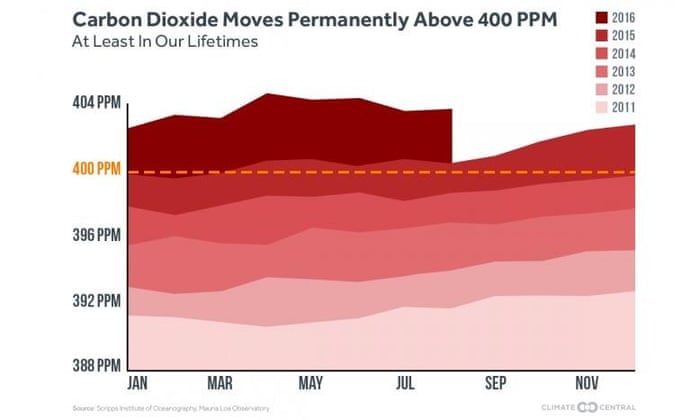
Image from The Guardian, 28 Sept 2016 https://www.theguardian.com/environment/2016/sep/28/the-world-passes-400ppm-carbon-dioxide-threshold-permanently
The carbon emissions have reached that critical point of over 400ppm where we are standing on an edifice with only catastrophic climate disasters ahead of us. Do you want to close your eyes and keep going or stand up and save the world?


So I will be praying with Standing Rock on Sunday December 4th at 4pm in the UK. Already I have been asked what good will my prayer do from here. Truthfully I don't know, but I am going to do it anyway and I really hope that you can all join me with this and support the Standing Rock Water Protectors in every way that you can.

Tuesday, 9 February 2016

Un-seasonal


Blue sky makes all the difference
The sky was blue today after yet another storm hit the UK. This was the 9th storm this winter which is more than the average.

Rain approaching
Storms in the UK are certainly not international news, no twisters or snowmaggedons. Just rather dull and continuous rain, accompanied by howling winds. There hasn't even been thunder and lightening to add some excitement. Some areas have experienced flooding or downed power lines, yet it is theunusual pattern of weather that makes it news-worthy for me.

Very wet and muddy dog walks
It is an El Nino year, which has spread a mixed bag of extreme weather across the world. Even so, I can't just shrug it off and expect next year to be 'normal' again. Have we had a 'normal' year in the last decade? A year when rainfall or temperature  records haven't been broken?

I wish rainbows were the only thing coming from this coal-fired power station.
The climate change predictions for the UK (that I read a good few years ago now), indicated that winters would be milder and wetter, with much less frequency of snow. Summers would also be milder and wetter, except for in the Southeast. This describes 2015 pretty well. Last summer was warm, but can anybody remember a day that was actually hot, like sunbathing-on-the-beach hot? We kept wondering when summer would start. And this winter has been exceptionally mild so far, though very wet and stormy.

Are we moving to a 'season-less' climate in the UK, with far less definition between spring and summer or autumn and winter? That is not to say that every year will be like that, just that a trend may be emerging. I mean we can't expect to ignore all the danger signs about climate change and not have to face the consequences.

Lovely traditional stone terraced housing
The good news is that buildings in the UK are built to withstand this kind of weather, at least most of the dwellings are. The majority of dwellings are built of brick or stone, and feel solid and secure whilst the wind is howling round them. The style is for low-rise, compact and often terraced dwellings. Even hurricane strength winds only result in a few chimney pots being toppled, trees falling and power lines being damaged. Watch the scenes in other areas of the world and whole streets of homes get reduced to matchsticks.
Old brick built factory still looking amazing
This is also why we have some of the oldest housing stock - brick houses are expensive and slow to build (compared to timber) and as they last well and are expensive to replace, we keep them. Even more so with stone dwellings. My friend's cottage is over 300 years old, and the thick stone walls would have taken an enormous amount of energy to demolish.

Any excuse for more nice photos
Now I know that old houses get a bad name for not being energy efficient, but that is not entirely true. They tend to be small, so have less volume to heat, and if they are terraced they reduce heat loss by having less external wall area. Houses were built with good natural light in all rooms, before we had electricity and had a cellar and a pantry instead of a fridge or freezer.
 

That is not to say that older buildings don't feel cold and draughty, but it is worth bearing in mind that a new efficient double-glazed window provides no more insulation than an old solid brick wall. Modern buildings with vast glazed areas are really not a great idea if you wish to reduce your heating bills. You will find that there is more focus on building houses airtight these days, to reduce unwanted draughts, and adding additional insulation to any building will always improve the thermal comfort and efficiency.
Survived since 1483
Other bloggers have noticed changes in their weather patterns too, sometimes major scary events like the forest fires and drought in Tasmania that Jo mentioned, or even small signs of change such as still picking raspberries in November as Mrs Thrift noted. I would love to hear of any changes that you may have noticed, wherever you are. It may be plants flowering earlier or areas flooding that have never been flooded before. It all helps to build up a picture of how the climate is changing and prepare us for what might come next.

Saturday, 24 January 2015

Selective news

I like reading the news on the internet, because it lets you pick and choose the most interesting stories, rather than watching half an hour of what someone else dictates as the 'top' stories. I am very selective, having no interest in celebrities or gossip, or the tit-for-tat that spews from the mouths of our politicians - glancing at a political headline is more than sufficient. Whereas some stories really grab my attention, and for a long while the weather related ones were some of them.

The BBC news site, my channel of choice purely because it doesn't have adverts, used to have a page devoted to weather news. I found it when I was doing a presentation on climate change and wanted some recent examples of extreme weather events. You could guarantee that there would be a flood or drought causing death and destruction virtually every single day, that would barely ever make it into the 'top stories'. You can see my 'weather scrapbook' summary for 2010 below. How many of those do you remember seeing on the news?

  • January saw significant widespread snowfalls across the UK. Not quite the 17.8 inches of snow that fell in Washington D.C. in February, which was their snowiest winter ever. Even Miami saw sub-zero temperatures for the first time in 20 years.
  • 125 deaths were reported from the severe cold in Northern India in early January.
  • Heavy thunderstorms and flooding caused 10 fatalities in Egypt in January.
  • Severe droughts hit southern and southwestern regions of China over the first part of the year, affecting 6.1 million hectares of farmland and leaving 18 million people short of drinking water.
  • The worst floods in a decade also swept through parts of China with more than 3,100 dying and included a devastating mudslide which left 1,471 people dead.
  • In May Tennessee saw epic floods killing 31 people in all and breaking the monthly record by the 2nd day of the month.
  • Cyclone Phet killed 24 people in Oman in June.
  • Devastating floods hit Pakistan in July and by August a fifth of the country was submerged. 20 million people affected and nearly 2,000 deaths.
  • July also saw a heatwave in Russia, the hottest since records began. A month of temperatures above 30 Deg. C also led to a severe drought and raging wildfires. Death toll is estimated at 50,000 from heat and air pollution. Crops were also badly hit and all exports of wheat have been stopped.
  • The UK had its wettest July ever recorded and flooding hit.
  • The Amazon rainforest suffered from an “exceptional” drought the worst in 108 years of records with entire stretches of river drying up completely.
  • November brought snow to the UK and throughout much of Europe and North America severe cold and heavy early snowfalls occurred. The Arctic however was unusually warm.
  • The Hurricane season saw 19 named storms, 12 hurricanes and 5 intense hurricanes, coming in 2nd place for the most hurricanes in a season after 2005. Luckily many of these did not make landfall.
  • 2010 was also the second hottest year globally on record, after 2005.
  • 19 countries set new records for the highest temperature in 2010, and one country set a record for the lowest temperature.

Since then it became harder and harder to find the weather-related stories on the BBC, and now I have given up looking for them. These events haven't just stopped happening, but whether through lack of funds, lack of interest or ulterior motives, far less are being reported.

It is becoming more and more obvious, that the BBC offers a tainted view of world affairs. Just as they are selective with climate/ weather related stories, they are selective in other areas too. So I now read RT news site as well, the Russian news channel which often has news from a different perspective than the BBC. (Plus it doesn't feature the leering face of David Cameron or his cronies quite so often.)

Mostly RT has the same stories, but there are differences. For instance regarding Eastern Ukraine the BBC will always refer to 'pro-Russian rebels' or 'Russian-backed separatists'. You can see this in todays report on the shelling of Mariupol where blame for the attack is immediately assigned to the rebels, who are then reported to deny this. The equivalent report from RT refers to the 'East Ukraine militia' in the text (although the initial photo uses 'pro-Russian rebels' in its description, though the image is from Reuters). The BBC give the impression they are showing the rebels' side of the story, by saying that the rebels deny the attack. However the RT report goes further and points out that the militias stronghold is 110km away and the militia are quoted as saying they have no heavy artillery within range of Mariupol.

The government in Kiev must know who attacked Mariupol. Either the government issued the orders themselves or they didn't and it was the rebels/ militia. But firing on civilians is an international offence, and they are hardly likely to incriminate themselves, so can we trust what they say? The same applies to the rebels. That is why I would expect there to be investigative journalists coming up with proof and interviewing witnesses, but when it comes to the shenanigans in Ukraine there really seems to be very little based on actual evidence and a lot based on what the different sides say. Our best hope may be from the OSCE but little seems to be reported from them either in the media. Gathering evidence is clearly a frustratingly slow process.

To me it feels like the invasion of Iraq pantomime all over again. "You have weapons of mass destruction!" says the US. "Oh no we don't!" say the Iraqis. "Oh yes you do!"  "Oh no we don't!"..... The trouble is that the truth didn't come out until after we went to war and half a million people died. Then it just became a big joke to some people, but to me it seems like an apology is due.


That is why I am interested in knowing the truth. The mainstream media just aren't providing that any more, and I would encourage you to question everything and share your doubts, while we still can. Do we really want to be blindly misled into another war?

...............................................................................................

Well I wrote the paragraphs above this morning and since then both the news articles I quoted have developed further. The BBC are saying that Aleksandr Zakharchenko, a rebel leader, has launched an offensive against the city port of Mariupol and takes responsibility for the rocket attacks, with the Ukrainian Prime Minister accusing Russia of breaching the Minsk agreements. Whereas RT are quoting Aleksandr Zakharchenko as saying that since it was the Ukrainian government who attacked Mariupol, they are launching an attack on the government positions to the East of Mariupol. And so the pantomime continues. Oh no it doesn't! Oh yes it does........... :-(